Follow what happens to water, hydrogen, oxygen and carbon dioxide across ZENIT’s Earth and Space concepts. Start with the reaction that connects Earth fuel production to spacecraft oxygen generation.
Electrolysis splits water
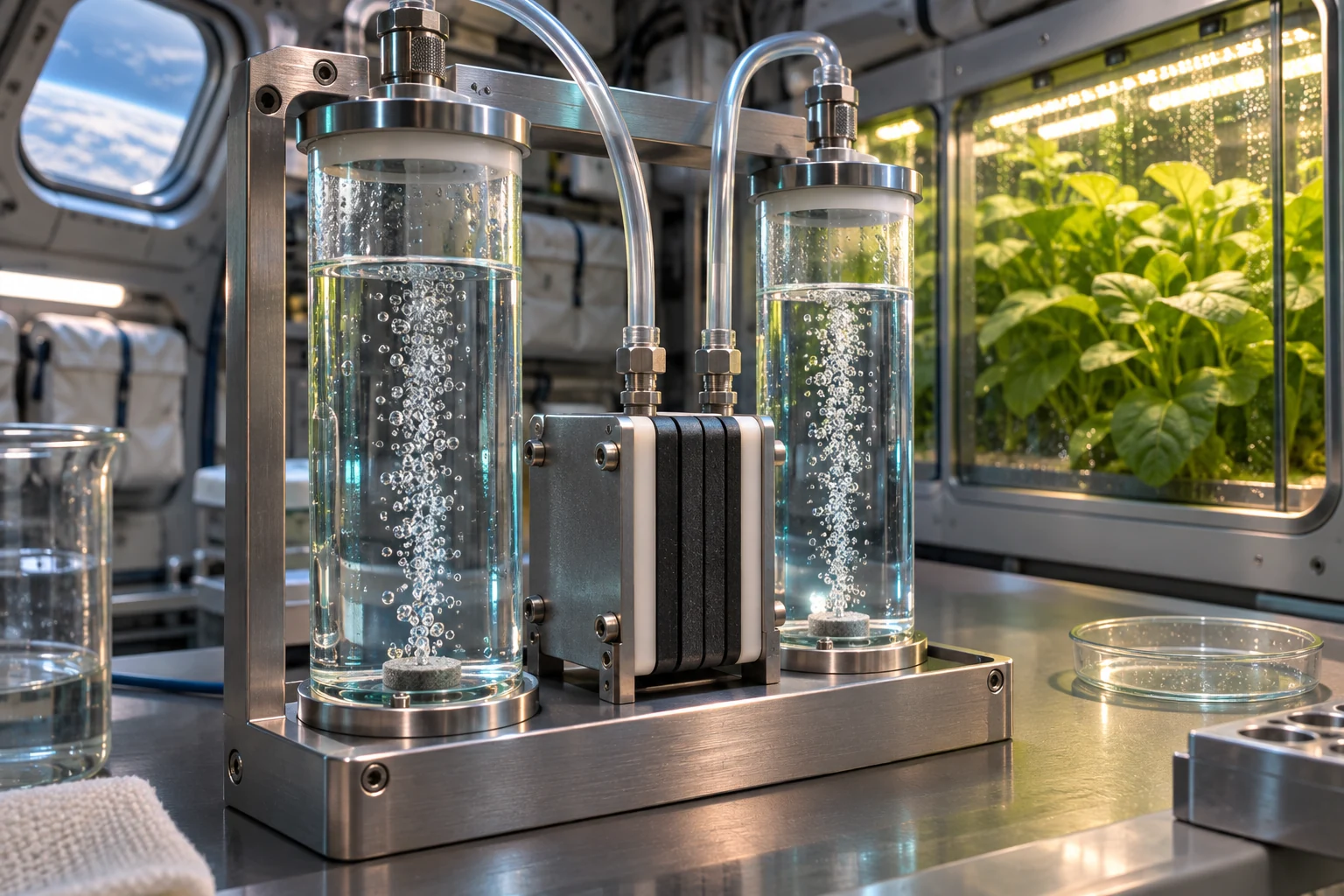
An electrolyser uses direct-current electricity to split treated water into two separate gas streams. In a proton exchange membrane (PEM) cell, hydrogen ions move through the membrane and electrons take a separate path through the external circuit.
Inside a PEM electrolysis cell2H₂O→produces2H₂ + O₂
External DC circuitThe DC supply draws electrons from the anode and supplies electrons to the cathode.
Water in · H₂O
Anode (+)
Water releases oxygen, protons and electrons.
2H₂O → O₂ + 4H⁺ + 4e⁻
Oxygen out · O₂
Membrane
4H⁺
Protons cross to the cathode.
Protons and electrons in
Cathode (−)
Protons and electrons combine to make hydrogen gas.
4H⁺ + 4e⁻ → 2H₂
Hydrogen out · H₂
Earth · Fuel production
In the Earth facility concept, SERAT supplies qualified electricity to an optional electrolyser. Hydrogen goes to conditioning and storage. Oxygen has its own handling route, and suitable recovered water can return to treatment.
In the Qi life-support concept, verified water feeds the oxygen generator. Oxygen goes to the cabin through a controlled feed. Hydrogen follows a separate handling path, and stored oxygen covers gaps in generation.
The first two figures follow from the reaction. Water treatment and cooling can increase facility water demand. The electricity figure is the U.S. DOE’s 2022 PEM system benchmark. At 50 g CO₂e/kWh, 55 kWh adds 2.75 kg CO₂e per kg of hydrogen from electricity alone. Conditioning and distribution add their own loads.
Energy basis. One kilogram of hydrogen carries about 33.3 kWh on a lower-heating-value basis. Dividing 33.3 kWh by the 55 kWh system input gives about 61% on that basis. LHV excludes heat that could be recovered by condensing the water vapour after combustion. This ratio covers the electrolyser system in the benchmark. Grid-to-wheel efficiency would also account for delivery and vehicle conversion.
Hydrogen combustion, fuel cells and batteries turn chemical energy into useful work along different paths.
Hydrogen combustion
2H₂ + O₂ → 2H₂O
Hot gas expands to move a piston or turn a turbine. High-temperature combustion in air can also form nitrogen oxides (NOₓ). The Earth concepts include the ZC-1 car, ZA-1 jet, ZA-P01 propeller aircraft, ZH-1 helicopter and the ZP-1, ZB-1 and ZCS-1 marine vessels.
Protons cross the membrane. Electrons travel through the load and reach the cathode, where water forms. The reaction releases both useful electrical energy and heat.
The PR-H1 and PR-H2 roadster concepts carry hydrogen and oxygen for their fuel cells. The fuel cell drives electrons through an external circuit to supply electric traction. Collected water could return to a compatible treatment system as part of a water recovery loop.
Electrical input → stored chemical energy → electrical output
Charging uses electrical work to change the state of the electrodes. Discharging drives electrons through the load while ions move through the electrolyte. ZENIT uses this principle in battery-electric roadsters, the fuel-cell roadsters’ buffer packs and SafeSpot reserves.
In a rechargeable lithium-ion cell, lithium ions move toward the positive electrode during discharge while electrons reach it through the external load. Charging drives both paths in reverse. Side reactions and changes to electrode materials can reduce recoverable capacity over repeated cycles.
Crew metabolism consumes oxygen. Cabin equipment and water recovery keep the supplies and waste streams in balance.
Crew respiration
C₆H₁₂O₆ + 6O₂ → 6CO₂ + 6H₂O
For complete aerobic oxidation of glucose, cells capture part of the released energy in ATP and release heat. The crew breathes oxygen and exhales CO₂ and water vapour. Cabin ventilation carries CO₂ to removal equipment and moisture to water recovery.
The Qi concept uses regenerable scrubbers. A scrubber captures CO₂ from circulating air, then releases it into a separate handling path during regeneration so the capture medium can work again. The current Qi design leaves the choice of capture medium open.
Condensate or eligible process water → treatment → quality check → reuse
Qi cabin condensate and suitable Earth process streams have separate recovery routes. A quality check determines whether recovered water can feed electrolysis. These references specify the treatment and verification step while leaving the exact treatment chemistry open.
This net equation uses glucose as the reference carbohydrate. Plants also respire, so the habitat’s net gas exchange depends on the light schedule, biomass and growing area. The baseline Qi crew supply relies on mechanical CO₂ removal and verified oxygen.
A Sabatier reactor can use captured CO₂ and hydrogen to make water and methane. The water can return to electrolysis. The methane carries some of the original hydrogen out of that loop.
CO₂ reduction
CO₂ + 4H₂ → CH₄ + 2H₂O
Electrolysis of the recovered water
2H₂O → 2H₂ + O₂
For one mole of CO₂ reacted in this ideal balance, electrolysis recovers one mole of oxygen gas and returns two of the four moles of hydrogen initially fed to the Sabatier reactor. The remaining hydrogen is bound in methane. Qi’s concept retains separate CO₂ and hydrogen handling paths.